How Much Does AI Cost for a Business in 2026? Honest Math
Md Ehsanul Haque

Last updated: June 29, 2026.
How much does AI cost for a business? Here is the honest answer up front. In 2026 it runs from $0 to roughly $400,000, and most small businesses land at the cheap end, often under the price of one streaming subscription per month. You do not need a crore in the bank to start. You need an afternoon.
Let me guess why you searched this. You suspect AI (software that can read, write, and answer questions for you, like a very fast junior assistant) is a rich-company toy, something only banks and giant tech firms can afford. So you typed "how much does ai cost for a business" half-hoping for permission to start, half-bracing to be told no. That fear has a source, and it is not your budget. It is the search results.
Open almost any guide on page one and the first number you see is "$40,000 to $400,000" for a custom build. A custom build means AI software made from scratch just for your company, like a tailored suit instead of one off the rack. Technically true. Practically, it quietly tells a small owner to give up before lunch.
At Ledgercross, we think that framing is lazy and a little cruel. The real story is the opposite. In SBE Council's 2026 small business tech survey, 82 percent of small employers had already invested in AI tools and 93 percent of AI users planned to keep investing (small sample, so treat it as a strong signal rather than gospel). They are not all dropping fortunes. They are renting smart tools by the month.
So here is what this guide actually gives you, no vendor sales pitch attached.
- A free-to-cheap starter stack you can stand up this week, in real monthly dollars, not "contact sales."
- The truth about when a custom build is worth it, and when it is a trap.
- Dead-simple payback math: hours saved versus money spent, measured in break-even weeks, not years.
How much does AI cost for a business? The short answer (and why $0 to $400,000 needs unpacking)
How much does AI cost for a business? Anywhere from $0 a month to several hundred thousand up front. That range is technically true and completely useless, like answering "how much does a vehicle cost?" with "somewhere between a used bicycle and a private jet."
So let me make it actually useful. AI pricing in 2026 comes down to three tiers.
- Free to DIY (under $100 a month): ready-made tools with the AI already baked in, like ChatGPT or Claude.
- Done-with-you tools and automation ($100 to $2,000 a month): off-the-shelf software plus a little setup that wires your apps together so repetitive work happens by itself. Automation just means a task runs without a human clicking every button.
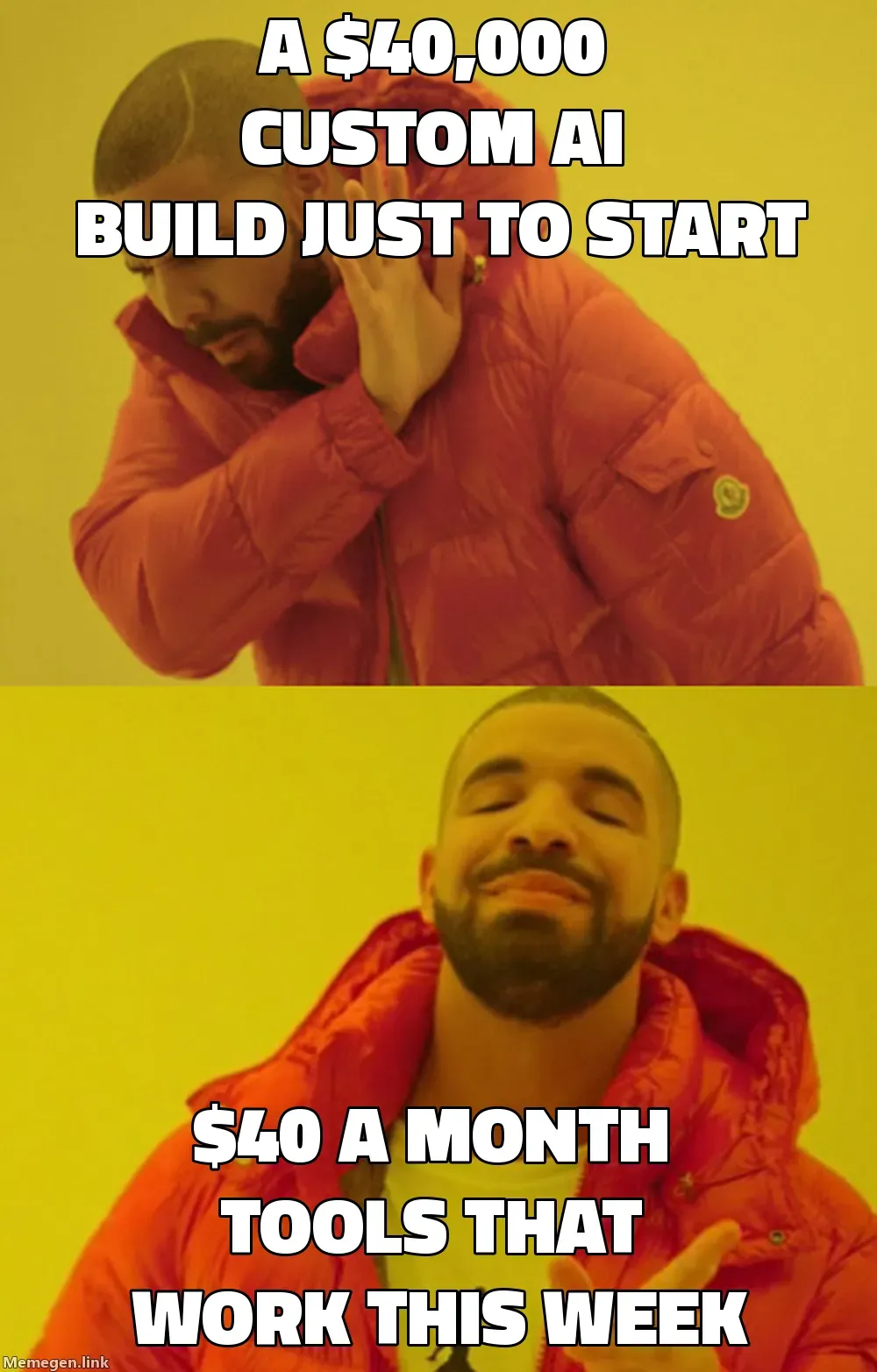
- Custom-built (a one-time bill plus ongoing upkeep): a developer builds something tailored to you. Estimates from AI development firms suggest these commonly run roughly $40,000 to $400,000 and up depending on scope (Uptech and CloudZero, as of 2026). Treat those as agency ballpark figures, not hard law.
Here is the part nobody says plainly. The price is set by who builds it and how custom it is, not by the AI itself. The same underlying "brain" (the model, the trained system doing the thinking) powers a $20 tool and a $300,000 system. You are paying for people and tailoring, not for a magic ingredient. Roughly four in five small businesses get real value from tiers one and two and never need a custom build. Start cheap. Prove it works. Scale only when the numbers beg you to.
Path 1: What does the free-to-cheap starter stack cost?
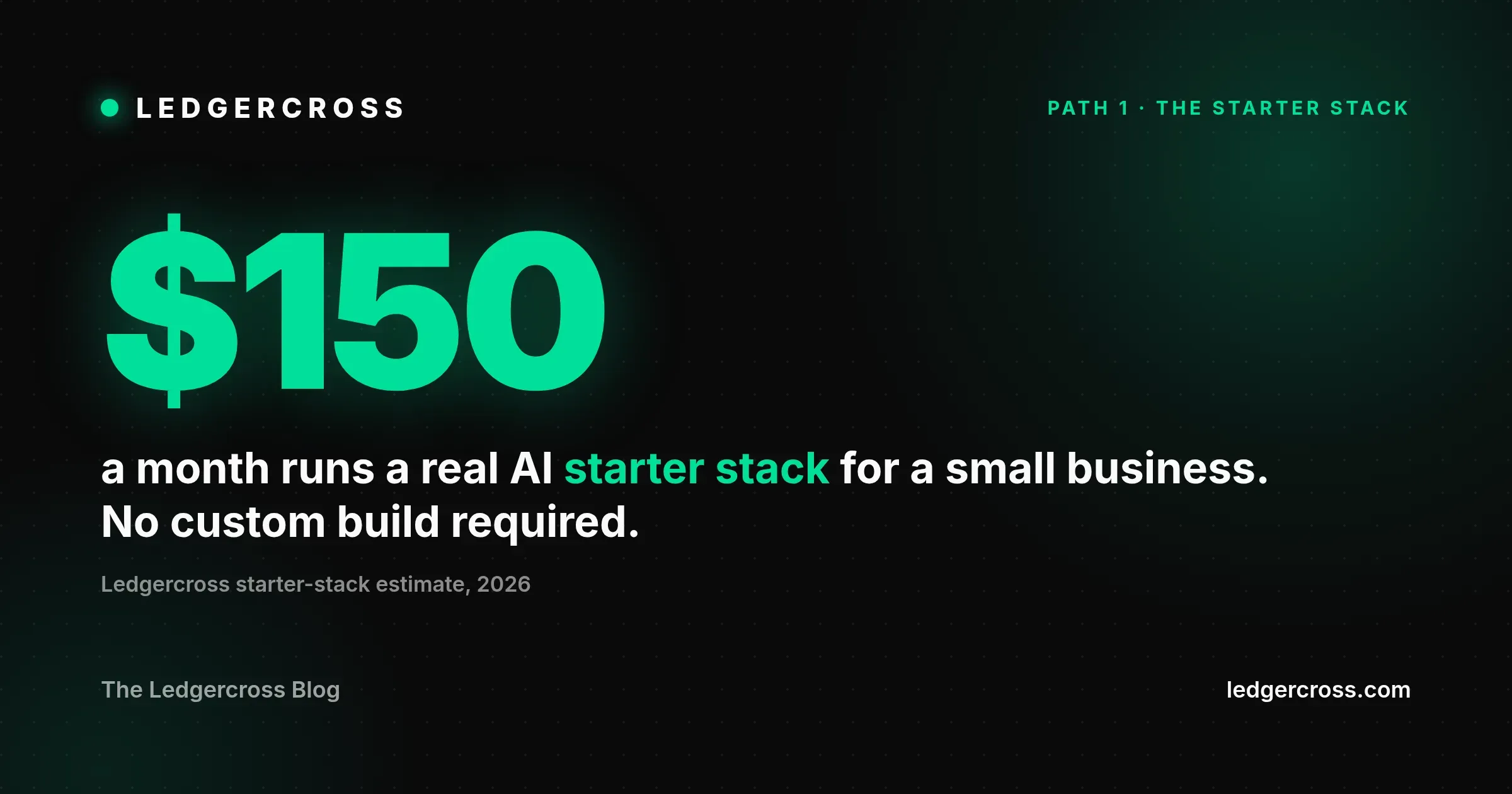
The honest answer at the starter level is this: most owners can run a real, useful AI setup for $0 to about $55 a month, with no developers and no big project. Here is a stack you could switch on this afternoon.
- A chat assistant (ChatGPT, Claude, or Gemini): an assistant you type a request into and it writes back, like texting an intern who never sleeps. Free to start, about $20 to $30 per user per month for the paid tier that handles longer documents and heavier work.
- A writing and design helper (Canva's AI features): free, or roughly $15 a month for pro.
- A connector tool like Zapier or Make that passes information between your apps automatically: this is what people mean by automation, software doing repeat steps for you. Free for light use, around $20 to $30 a month as you grow.
That is a full working kit, and the cost is pocket change. The first real bill most owners ever pay is just one assistant that drafts customer replies, social captions, and product descriptions. Say writing eats five hours of your week. Hand the first draft to the assistant and you spend about thirty minutes editing instead. That is roughly four and a half hours back, every week, for the price of two coffees a month.
The connector layer is the cheapest, least scary piece. Think of every time you copy a name from a contact form into a spreadsheet, then paste it again into your email tool. A no-code tool (software you set up by clicking, not by writing code) does that copying for you, forever, while you sleep. Most small businesses never outgrow the free tier in year one.
So what does a starter budget really total? For a team of one to five people, a working stack usually lands under $100 to $150 a month, all in. Compare that to one part-time hire. In Bangladesh, part-time help might cost $150 to $300 a month. In the US, closer to $1,200 plus. Your entire AI setup often comes in under what you would pay one person for a few hours a week. This is the on-ramp the companies actually winning with AI in 2026 almost all started on.
Path 2: What does a custom build cost, and what makes the price jump?
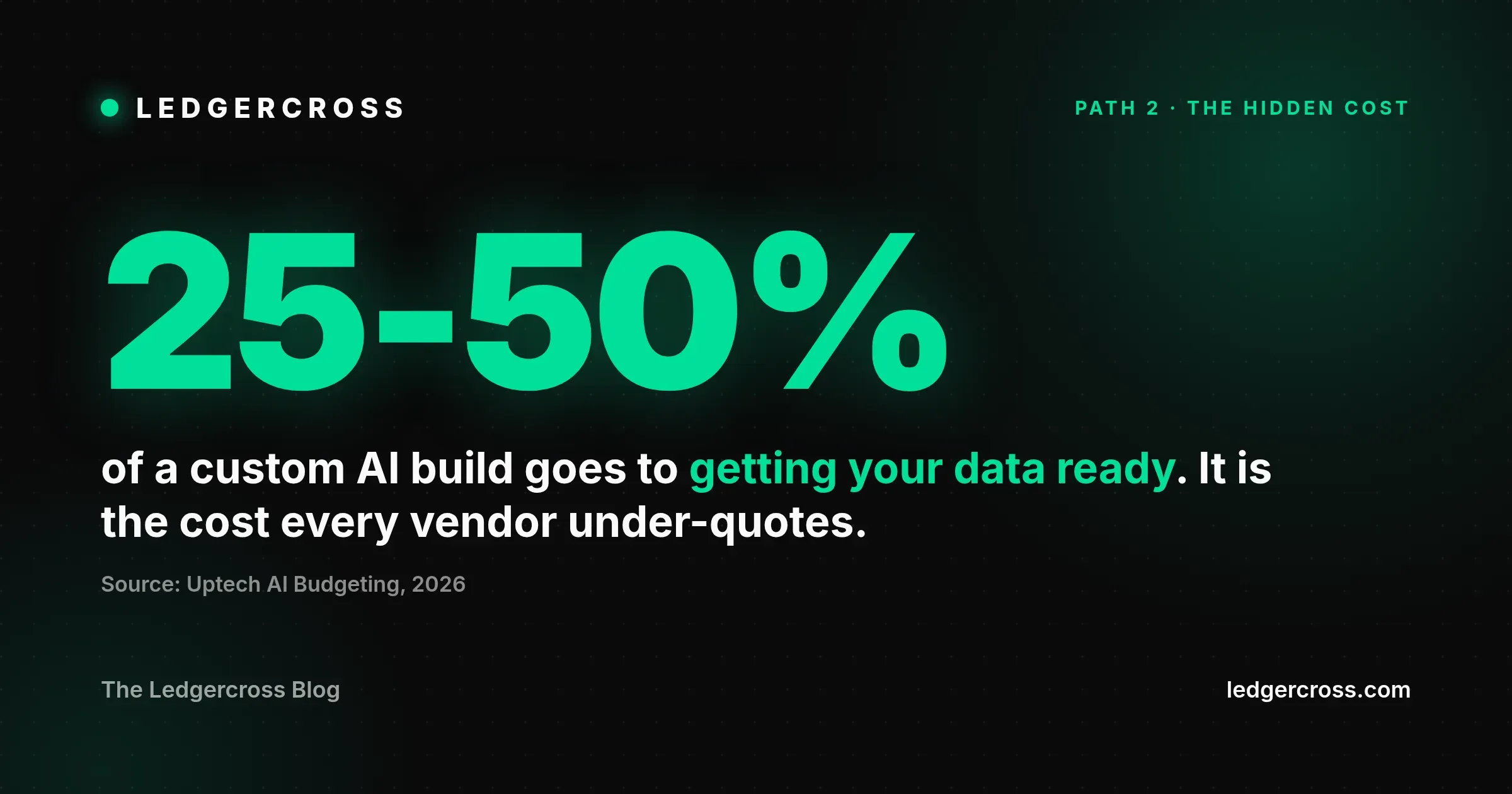
So how much does AI cost for a business when you go custom? Estimates from AI development firms put most custom projects between roughly $40,000 and $400,000 depending on scope (Uptech, 2026). That spread is exactly why the number feels random. It is not.
First, the honest part: most small businesses never need this. You only reach for a custom build when the cheap starter stack genuinely cannot do the job. Four real triggers.
- Unique workflows that no off-the-shelf tool understands, so the software has to be shaped around you.
- Deep integration, wiring the AI straight into your accounting, inventory, or customer database so it acts on live data instead of you copying and pasting.
- Proprietary data, training or grounding it on your own private documents that no public tool has ever seen.
- Regulated industries like finance, health, and law, where rules about where data lives add compliance work, and cost.
Now the biggest hidden cost, the one nobody quotes out loud. Cleaning up your own records typically eats about 25 to 35 percent of a custom project's direct budget, and 50 to 70 percent of its timeline (CloudZero, 2026). AI is only as smart as the stuff you feed it. Feed it tidy, consistent records and it shines. Feed it three spreadsheets where "customer" is spelled four ways, invoices trapped in PDFs, and notes buried in someone's inbox, and it chokes. Somebody has to gather and organize all of it first. Vendors under-quote this because they cannot see your shoebox of records during a sales call, so the proposal assumes your data is clean. It rarely is.
Two more line items ride on top. There is the running cost, called "inference," which is just the AI doing work: generating a reply, a summary, a sorted invoice. Think of it like electricity, a tiny charge per use, more in a busy month. For most small businesses that lands in the tens of dollars, not the thousands. And there is upkeep, because software is never "done." Budget a recurring 15 to 20 percent of your setup cost per year for maintenance and monitoring. For context, companies expect to spend about 1.7 percent of revenue on AI in 2026, more than double 2025's roughly 0.8 percent, according to BCG's 2026 AI Radar survey. Custom is a real lever. Just pull it on purpose, not out of fear.
The payback calculator: when does AI pay for itself?
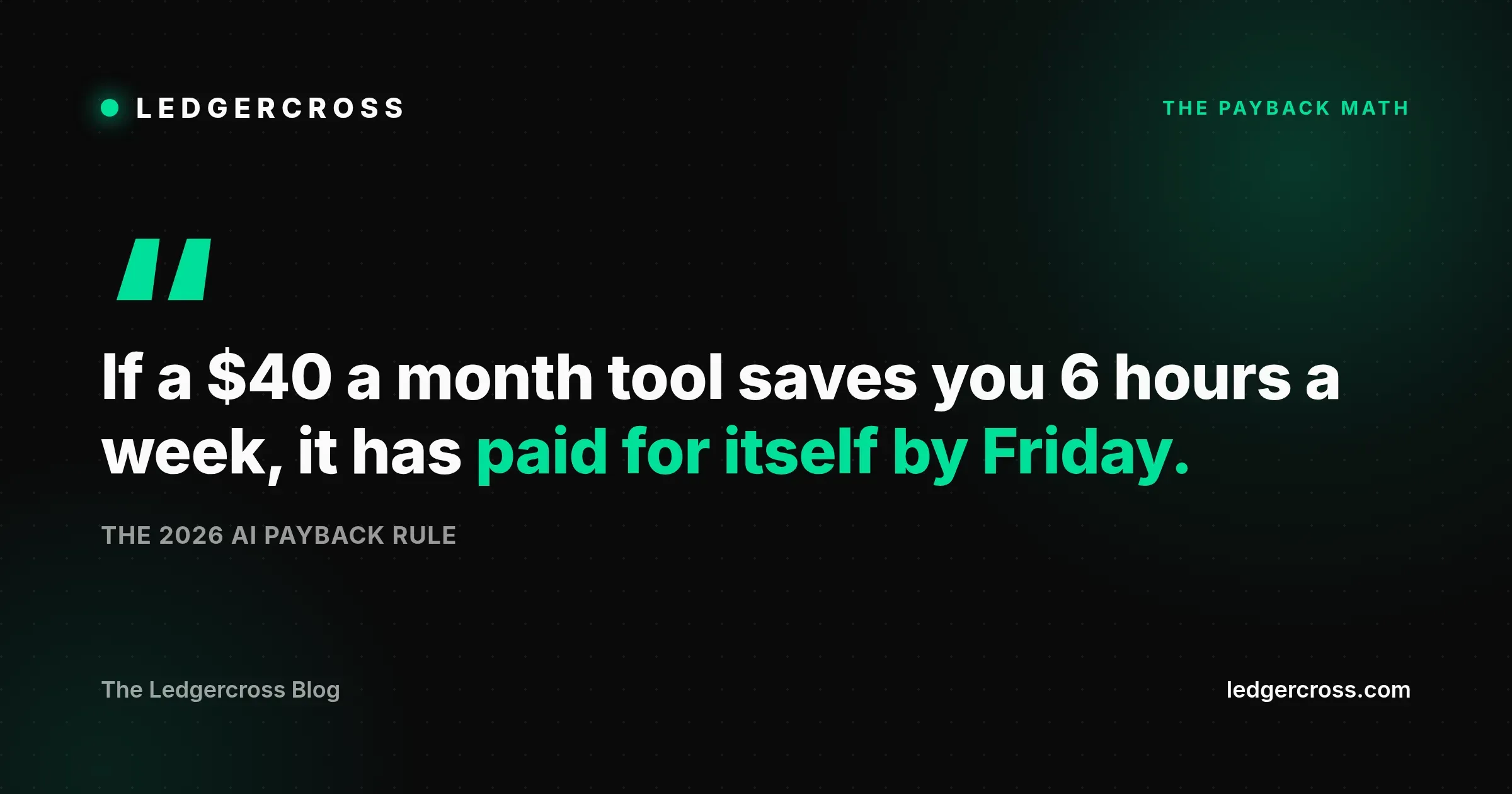
Here is the answer no vendor page will give you. An AI tool pays for itself the moment the hours it saves each week, multiplied by what an hour of your team's time is worth, beats what the tool costs per month. For cheap tools, that is usually week one, not year three.

Run real numbers. A tool costs $40 a month and saves you six hours a week. Value your time modestly at $15 an hour. That is six times $15, so $90 of time saved in a single week against a $40 bill. It pays for itself before the first week is over, then prints value every week after.
Now the big one. Take a $48,000 custom project and spread it evenly over twelve months. That is $4,000 a month. To break even, it has to save roughly a full person's workload, around 40 hours a week at $25 an hour. Real, but only at real scale. So the rule of thumb: if a tool does not pay back within 8 to 12 weeks, start smaller. No shame in it. Almost nobody started with a six-figure build.
The Bangladesh and SME leapfrog angle: you do not need Silicon Valley money

Here is the honest answer if you are running a small shop in Dhaka, Chattogram, or anywhere outside the funding bubble. A starter stack runs roughly $20 to $100 a month, while one junior hire in Dhaka costs you 20,000 to 35,000 taka every single month. The tools are not the expensive part. The salary is.
That gap is the whole story. For less than the price of a few cups of cha a day, a two-person shop can push out work that used to need a much bigger team. Your competitor with the big office and the big payroll is not faster anymore. They are just heavier.
At Ledgercross, we believe emerging-market SMEs hold a quiet advantage. You never built the expensive legacy systems the West is now trapped paying for, so you get to skip straight to a lean setup, the same way the country leapfrogged landlines and went mobile-first. You build your digital fortress directly, no decade of costly mistakes in between. A quick word of caution: the global stats in this article (McKinsey, BCG, Zylo, SBE Council) describe US and worldwide businesses, not Bangladesh specifically. The leapfrog is an inference from the math, not a cited local figure. But the math is plain. If you are nervous about being left behind, the real danger is staying stuck in yesterday's tech, which is the only move that actually costs too much. Stop renting your future from people who want you to think it is unaffordable. Start owning it.
What five cost mistakes make AI look more expensive than it is?
The scary number people hear is usually a self-inflicted wound. AI is rarely expensive. The way you buy it is. Dodge these five.
- Building custom before testing cheap tools. Test an off-the-shelf tool for a few dollars first, then build only what proves its worth.
- Paying per seat for people who barely log in. Per-seat pricing charges you for every person you add. Buy seats for active users only.
- Ignoring data cleanup until it ambushes you. It can eat 25 to 35 percent of a custom build's budget. Plan for it up front.
- Buying hype instead of one painful task. Pick one boring, repeatable job that hurts every week. Not "transform the business." One task.
- Skipping the human-approval step. A quick human sign-off early on is the cheapest insurance you will ever buy.
Key takeaways
- Real AI cost in 2026 ranges from $0 to six figures, and most small businesses thrive at the bottom, under $150 a month.
- The model itself is cheap. You pay for people, tailoring, and especially data cleanup, which can swallow 25 to 35 percent of a custom budget.
- A ready-made starter stack launches this week with no developers and no setup cost.
- Custom builds are a real but optional lever, justified only at genuine scale.
- Judge every tool by payback. If it does not earn back its price within 8 to 12 weeks, start smaller.
- Want more plain-English help? Browse more plain-English AI guides on the Ledgercross blog.
Frequently asked questions
How much does AI cost for a small business per month?
A practical starter stack for a 1 to 5 person business usually costs under $100 to $150 per month in 2026. That typically covers an AI assistant (around $20 to $30 per user) for replies and content, plus a no-code automation tool to remove repetitive tasks. Many owners start on free tiers and pay nothing until they see value.
Is AI expensive to set up?
It does not have to be. Off-the-shelf AI tools require no setup beyond signing up, so your setup cost is essentially zero. Cost only climbs when you commission a custom-built system tied into your own data and software, which is a separate, optional decision most small businesses never need at the start.
Why do some AI quotes say $40,000 or more?
Those quotes are for custom-built solutions, where most of the money goes to cleaning and organizing your data (often 25 to 35 percent of the budget and far more of the timeline), integrating with your existing systems, and ongoing maintenance. The AI model itself is rarely the expensive part. For common tasks, ready-made tools deliver similar value for a tiny fraction of the price.
What is the cheapest way to start using AI in my business?
Start with a free AI assistant for one painful, repeatable task, such as drafting customer replies or product descriptions. Add a free-tier automation tool to connect your forms and email. Prove it saves time first, then upgrade only the tools that earn their keep.
How do I know if AI is worth the cost?
Use a simple payback check. Multiply the hours AI saves you each week by your hourly cost, then compare that to the monthly tool price. If a $40 per month tool saves 6 hours a week, it can pay for itself in the very first week. A good rule is to skip anything that does not pay back within 8 to 12 weeks.
What ongoing costs should I expect after buying AI?
For ready-made tools, the ongoing cost is just the monthly subscription. For custom systems, budget for usage costs (the inference meter that charges each time the AI runs a task) plus maintenance and monitoring, often around 15 to 20 percent of the build cost per year.
Can a business in Bangladesh or an emerging market afford AI?
Yes, and often more easily than expected. A starter AI stack can cost less per month than a junior hire's daily wage, letting small businesses skip expensive legacy software and leapfrog straight to lean, modern operations. You do not need Silicon Valley budgets to compete.
Stop guessing, start owning
You are not behind, and you are not priced out. The honest answer is that most owners should start at the cheap end and grow into the rest only when the money clearly works. So stop guessing at vendor pricing pages. Book a free AI cost and fit consultation and we will map the cheapest path that actually fits your business, with real monthly numbers and an honest payback estimate before you spend a single taka. Start small. Grow on proof.