Where Does Trust Actually Live on a Blockchain? A 2026 Map

Chandrima Dam
Software Developer
Last updated: 30 July 2026.
In February 2025, the exchange Bybit lost about 1.5 billion dollars, the largest digital heist in crypto history, according to Chainalysis. Nothing about the blockchain broke. Ethereum checked every signature and did exactly what it was told. Investigators at Sygnia traced the theft to a compromised developer machine at Safe{Wallet} and tampered front end code, the code that draws the screen a human reads before approving a transfer. Safe said its smart contracts were unaffected. The signers approved a transaction that was not the one they were shown.
Which raises the question nobody answers straight: where does trust live in blockchain, if not in the chain? It does not disappear. It relocates.
Does blockchain eliminate trust, or does it just move it?
It moves it. "Trustless" was never a promise that no trust is required. It means you do not have to trust the person on the other side of a transaction, because the rules run identically no matter who they are.
Ethereum co-founder Vitalik Buterin, in his August 2020 essay Trust Models, defines trust as "the use of any assumptions about the behavior of other people". His label for blockchains reframes everything: they are "N/2 of N", systems that "work if the majority of the miners (or PoS validators) are honest". A trust assumption written into the design, not the absence of one.
Where does trust live in blockchain? Five roles, five keyholders
Trust moves into five specific roles. Every one is a person or small group holding a key, not a piece of mathematics. The upgrade is real, because that new trust is countable, inspectable and separable in a way a back office never was. It only counts if you look.
The evidence is a security list, not a theory. The OWASP Smart Contract Top 10 for 2026 analysed 122 incidents from 2025 totalling about 905.4 million dollars in losses. Access control ranks first, price oracle manipulation third. You will not find a broken hash function or a failed consensus anywhere on that list. Every entry is about permissions, logic or inputs, which is to say about people.
| Who holds the trust | What breaks | Ask them |
|---|---|---|
| Whoever can upgrade the contract | Your agreement changes under you | How many approvals, and is there a delay? |
| Whoever signs the bridge | Value released against a transfer that never happened | How many signers, and are they independent? |
| Whoever feeds the price | The contract acts correctly on a false number | Which sources, and what if they disagree? |
| Whoever holds keys and front end | You approve what you were never shown | Who controls the domain, keys and deploys? |
| Whoever writes the rules | Terms change legitimately, not in your favour | Who can pass a proposal alone? |
Whoever can upgrade the contract
Most live contracts ship with an upgrade switch so bugs can be fixed, which means somebody holds a master key to the agreement you signed. For 2026, OWASP added Proxy and Upgradeability Vulnerabilities as a new category at number ten, the first entry driven by governance failure rather than a coding bug. Not a broken algorithm. An unguarded switch.
Whoever signs the bridge
A bridge moves value between two chains that cannot see each other, and it works because someone vouches that something really happened on the other side. On 18 April 2026, attackers linked to North Korea's Lazarus Group took roughly 292 million dollars from Kelp DAO's LayerZero bridge, per Chainalysis. Neither chain failed. A forged message was believed.

Whoever feeds the price
A blockchain cannot see anything outside itself, so an oracle is whatever service tells it the price. On 20 January 2026, an attacker borrowed about 280 million dollars in a flash loan purely to bend the price in a Curve pool that Makina Finance's oracle read as truth, and left with roughly 4.1 million dollars, per Verichains. The code was not broken. It was made to do the wrong thing perfectly, on a number rented for one block.
Whoever holds the keys and the front end
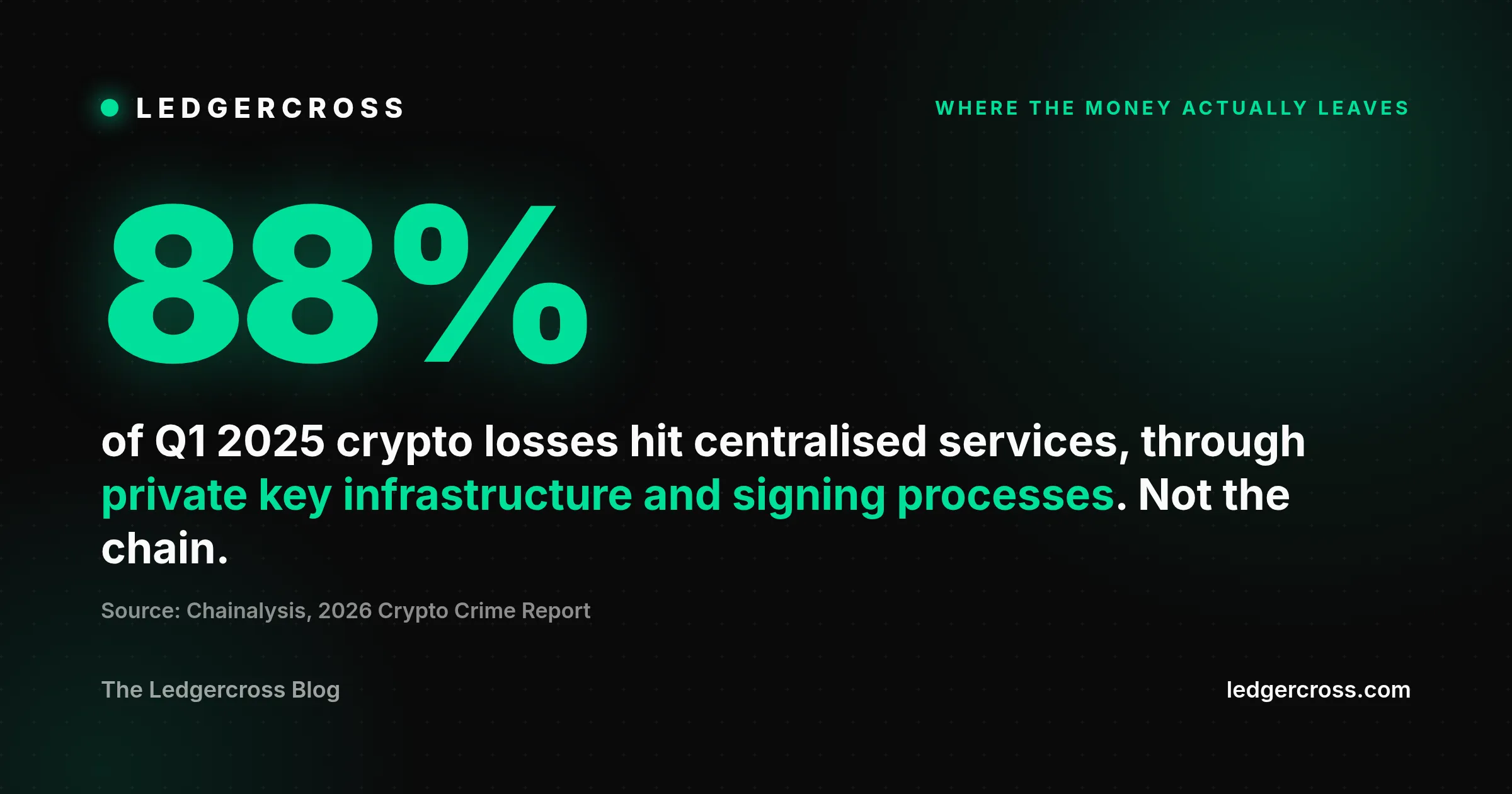
You never touch a chain directly. You touch a website that talks to one, and that website has a domain, a hosting account and a deploy pipeline as hackable as any other. Chainalysis reported that centralised services accounted for 88 percent of losses in the first quarter of 2025, through attacks on private key infrastructure and signing processes. The most decentralised system in the world is still reachable through one ordinary hosting account, which is why who can prove they are allowed matters more than the chain does.
When should a business skip the blockchain?
Skip it when one party can already be trusted to hold the record. Most problems described to us as blockchain problems are database problems with a trust story attached. At Ledgercross, we believe saying that out loud beats another pitch deck. Use a plain database when:
- 1One authority is already accepted by everyone involved.
- 2The data is private and must stay private, because you cannot unpublish a shared ledger.
- 3The record rests on a human claim nobody verifies. Writing "organic" to an immutable ledger does not make the mango organic, it makes the claim permanent.
- 4You need to reverse mistakes fast. Finality is a feature until it is aimed at you.
A chain earns its cost when several parties who do not trust each other must agree on one history: trade documents, land records, payment rails, provenance between competitors. That is also the case for the decentralized web and for proving who you are without handing over everything.
What does this mean for Bangladesh?
Building later lets you choose where trust lives instead of inheriting a century of choices somebody else made for you. That, not newer technology, is the real advantage.
In September 2020, Standard Chartered, bKash and Valyou launched Bangladesh's first blockchain based cross border remittance service, moving wages from Malaysia into bKash wallets. Trust did not vanish from that transfer. It moved to a named consortium you can point at. Land records are the clearest case still open: the problem was never storage, it was that one plot could carry several equally official looking histories. A shared ledger fixes disputed authority, not data entry, and it creates new keyholders while doing so. Name them, or the country swaps an opaque paper process for a faster digital one. That is why we entered Bangladesh's blockchain industry: leapfrogging means skipping the mistakes, not the questions.
What should you ask before you sign anything?
Five questions, one per role on the map. Each can go into a vendor email today without you learning a line of code.
- 1Who can change this after it goes live, how many approvals does that take, and is there a delay before changes take effect?
- 2Who vouches when value crosses between systems, how many of them are there, and are they independent?
- 3Where does every external number come from, and what happens when two sources disagree?
- 4Who converts this token back into money in our account, and who verifies they can?
- 5Who controls the domain, the front end and the keys, and what breaks when that person leaves on Friday?
Good answers carry names, counts and delays: "four signers, three required, two external, 48 hour timelock". A bad answer is "it's trustless", which usually means nobody counted the humans.
Frequently asked questions
Is blockchain actually trustless?
So how do blockchains keep getting hacked if they are so secure?
Stop renting your trust, start owning the list
The deliverable that matters is not a whitepaper. It is a one page list of every party who can move, freeze or upgrade anything, with the approval count and the delay next to each name.
Book a trust architecture review and let us count the humans together, before someone else counts them for you.